Updated: August 2026
Marriage can be one of the most meaningful relationships in a Muslim’s life, but even a strong marriage can go through periods of conflict, emotional distance, financial pressure, family tension, or communication problems. Seeking help does not necessarily mean that a marriage is failing. Often, it means that both spouses are willing to understand the problem and work on it before it becomes more serious.
Islamic marriage counselling combines relationship guidance with Islamic values such as rahmah (mercy), sabr (patience), shura (mutual consultation), responsibility, and accountability. Depending on the counsellor’s qualifications and approach, sessions may also incorporate established relationship-counselling techniques alongside faith-based guidance.
Quick Answer: What Is Islamic Marriage Counselling?
Islamic marriage counselling is relationship counselling that takes Islamic beliefs, values, family dynamics, and religious expectations into account while helping couples address practical relationship problems. It may focus on communication, conflict resolution, trust, emotional connection, finances, family boundaries, parenting, and preparation for marriage.
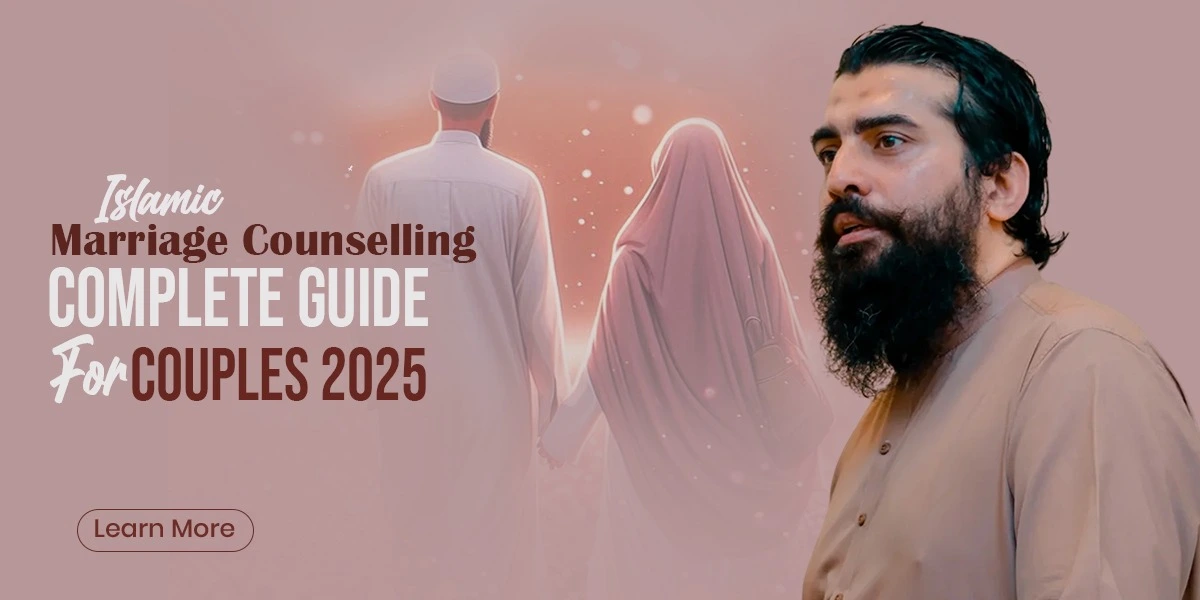
For couples looking for faith-aligned guidance, Shaykh Atif Ahmed’s Islamic Marriage Counselling service offers one-to-one guidance for married and engaged couples, with online and in-person options described on the service page.
Table of Contents
What Is Islamic Marriage Counselling?
Islamic marriage counselling is a structured form of relationship support that considers both the couple’s interpersonal problems and the Islamic values that shape their understanding of marriage.
For Muslim couples, relationship problems are not always limited to communication or personality differences. Expectations around religious practice, gender roles, finances, parents, children, cultural traditions, privacy, and family responsibilities can all influence a marriage.
A faith-sensitive counsellor can help a couple discuss these subjects in a way that respects their beliefs while keeping the conversation practical and constructive.
It is important, however, to distinguish between religious guidance and professional mental-health treatment. Not every person who provides Islamic relationship advice is a licensed therapist or clinical professional. Couples should therefore check the counsellor’s qualifications and understand what type of service they are receiving.
Islamic Foundations of Marriage Counselling
The Qur’an presents marriage as a relationship in which spouses can find tranquillity, affection, and mercy. Qur’an 30:21 refers to Allah creating spouses so that people may find tranquillity in them and describes affection and mercy between spouses.
The Qur’an also describes marriage as a mithaqan ghalizan, or solemn covenant, in Qur’an 4:21. These principles provide an important ethical framework for thinking about marriage and reconciliation.
In practical counselling, several Islamic concepts can be particularly relevant:
- Rahmah:
approaching disagreements with mercy rather than humiliation or contempt. - Sabr:
developing patience when a relationship is going through difficulty. - Shura:
making important family decisions through consultation rather than unilateral control. - Adl:
maintaining fairness and avoiding injustice within the relationship. - Taqwa:
remembering one’s accountability before Allah when dealing with a spouse. - Islah:
working toward reconciliation and constructive improvement when reconciliation is appropriate.
These concepts should not be used simply as religious slogans. Good counselling translates values into practical behaviour: listening carefully, communicating respectfully, taking responsibility, setting reasonable boundaries, and making mutually understood decisions.
When Should a Muslim Couple Seek Counselling?
Couples often wait until a disagreement has become severe before asking for help. Earlier support can sometimes make the situation easier to address.
Consider seeking qualified support when:
- the same argument keeps happening without resolution;
- communication has become hostile, dismissive, or extremely limited;
- one or both spouses feel emotionally disconnected;
- financial disagreements are repeatedly damaging the relationship;
- in-law or extended-family involvement is creating ongoing conflict;
- there are major disagreements about parenting;
- religious expectations are causing repeated arguments;
- trust has been damaged and both spouses want to understand whether it can be rebuilt;
- you are preparing for marriage and want to clarify expectations before nikah;
- you want guidance even though the marriage is currently stable.
Seeking counselling is not automatically an admission of failure. For many couples, it is simply a structured way of dealing with an issue that has become difficult to solve alone.
Common Marriage Problems Addressed in Islamic Counselling
Communication Problems
Many marital disagreements become worse because spouses feel unheard rather than because the original issue is impossible to solve. Counselling can create a structured environment where both partners can explain their concerns without immediately turning the conversation into another argument.
Financial Disagreements
Money can create tension around spending, saving, debt, household responsibilities, employment, and expectations about financial support. A counselling conversation can help couples separate the financial facts from assumptions and establish clearer expectations.
Family and In-Law Boundaries
Extended family can be an important source of support, but unclear boundaries can also create marital tension. Couples may need to discuss privacy, visits, decision-making, financial involvement, and how disagreements with relatives should be handled.
Parenting Differences
Spouses may agree about wanting a good Islamic upbringing for their children but disagree about discipline, education, technology, schooling, or family routines. Counselling can help them identify the principles they share and develop practical agreements.
Trust and Emotional Distance
Trust can weaken after repeated dishonesty, broken promises, unresolved conflict, or emotional disconnection. Rebuilding trust usually requires more than simply asking a spouse to “move on.” It requires accountability, consistency, honest communication, and realistic expectations about the recovery process.
Religious and Cultural Differences
Couples may come from different cultural backgrounds or have different expectations about religious practice. A counsellor who understands Muslim family dynamics can help distinguish genuine religious requirements from cultural assumptions.
How Does Islamic Marriage Counselling Work?
The exact structure depends on the counsellor and the needs of the couple, but a useful counselling process generally begins with understanding the problem before attempting to solve it.
1. Initial Assessment
The counsellor learns about the couple’s concerns, relationship history, current conflict patterns, and goals.
2. Identifying the Core Problems
Some arguments are symptoms of a deeper problem. For example, repeated arguments about household chores may actually involve resentment, unequal expectations, poor communication, or feeling unappreciated.
3. Faith-Sensitive Guidance
Where appropriate, Islamic principles can provide a shared ethical framework for communication, responsibility, forgiveness, consultation, and family life.
4. Practical Relationship Work
The couple may work on listening skills, communication patterns, conflict management, boundaries, expectations, and specific relationship goals.
5. Follow-Up
Progress normally requires practice outside the counselling session. Couples may therefore review what has changed, what remains difficult, and which behaviours need continued attention.
Shaykh Atif Ahmed’s current marriage counselling service describes a similar practical structure: understanding the couple’s concerns, providing tailored guidance, and offering follow-up support.
View the Islamic Marriage Counselling service.
Islamic Marriage Counselling vs. Conventional Marriage Counselling
The main difference is not necessarily that one approach discusses relationships and the other does not. The difference is the worldview and framework used during the counselling process.
| Aspect | Islamic Marriage Counselling | Conventional Marriage Counselling |
|---|---|---|
| Values | Can explicitly incorporate Islamic beliefs, ethics, and family values. | Usually works from a professional psychological or therapeutic framework. |
| Spirituality | May include Islamic spiritual principles where appropriate. | May include spirituality when relevant to the client’s preferences and the therapist’s approach. |
| Family context | Can pay particular attention to Muslim family, cultural, and religious expectations. | Can address family systems and cultural factors depending on the therapist. |
| Relationship goals | Can combine relationship improvement with faith-aligned marital responsibilities. | Usually focuses on relationship functioning, communication, emotional wellbeing, and agreed therapeutic goals. |
Islamic counselling should not be presented as automatically superior to conventional professional therapy. The right choice depends on the couple’s needs, the counsellor’s qualifications, and whether the service can appropriately address the problem.
Benefits of Islamic Marriage Counselling
Better Communication
Couples can learn to communicate concerns without turning every disagreement into a personal attack.
Clearer Expectations
Discussing responsibilities, finances, family boundaries, parenting, and religious expectations can reduce assumptions.
Faith-Aligned Guidance
For Muslims who want their relationship decisions to reflect their religious values, an Islamic framework can provide a meaningful shared reference point.
Earlier Conflict Resolution
Professional or structured guidance can help couples address recurring problems before they become deeply entrenched.
Greater Self-Awareness
Marriage counselling is not only about identifying what the other spouse is doing wrong. A productive process also asks each person to examine their own reactions, expectations, communication habits, and responsibilities.
A 2024 mixed-method study involving 205 married respondents and follow-up interviews found that many participants dealing with marital problems valued spiritual practices, self-reflection, and guidance from religious figures. The researchers concluded that a religious perspective was an important factor in how these couples understood and sought help for marital problems.
Islamic Premarital Counselling: Preparing Before Nikah
Marriage counselling is not only for couples who are already experiencing serious problems. Premarital counselling can help engaged couples discuss important issues before they become sources of conflict.
Topics may include:
- religious practice and spiritual expectations;
- financial responsibilities and spending habits;
- career and education plans;
- children and parenting;
- living arrangements;
- relationships with parents and extended family;
- household responsibilities;
- communication styles;
- conflict management;
- personal boundaries and privacy;
- expectations about married life.
For a detailed question-based preparation process, see Islamic Premarital Counselling Questions Every Couple Should Discuss . You can also explore the site’s guide to Halal Marriage and Pre-Marital Islamic Counselling
Research published in 2021 examined Islamic premarital counselling specifically in relation to readiness for household life, using a pretest/posttest experimental design.
Real-World Case Study and Research Evidence
Published Case Example: A Couple Facing Severe Marital Conflict
This is an externally published case example, not a claim about a Shaykh Atif Ahmed client.
Rahmaa Institute published a testimonial from a married couple who described experiencing severe conflict and separation during the early years of their marriage. According to the published account, attempts by family members and an imam to intervene had not resolved the underlying anger-related problems. The couple then received counselling and anger-management support through Rahmaa Institute.
The testimonial describes the couple learning healthier ways to respond to anger and support each other, while the counsellor combined counselling techniques with Islamic teachings. The couple reported that the process helped them move toward a healthier marriage.
The important lesson is not that counselling guarantees reconciliation. Rather, the case demonstrates why recurring conflict may require structured intervention instead of relying only on repeated informal advice from relatives or community members.
What Research Says About Muslim Couples Seeking Islamic Counselling
There is also emerging research specifically examining Islamic counselling for marital problems. A 2024 study in the Tazkiya Journal of Psychology surveyed 205 married respondents and conducted in-depth interviews with three participants. The researchers found that many respondents relied on positive thinking, information-seeking, self-reflection, increased worship, and religious guidance when dealing with marital problems.
A 2026 qualitative study involving six married couples who had experienced at least three Islamic-based family therapy sessions reported improvements associated with communication, emotional self-regulation, spiritual awareness, and constructive problem solving. The study also emphasized that continued religious commitment and ongoing counselling support were important factors.
These studies are useful evidence for the role of culturally and religiously sensitive support, but they should not be interpreted as proof that every Islamic counselling programme will produce the same outcome. Individual results vary.
Online Islamic Marriage Counselling
Online counselling can be useful for couples who live in different cities, have demanding schedules, or cannot easily access a suitable counsellor locally.
Before booking an online session, check:
- who will conduct the session;
- what professional or religious qualifications they hold;
- whether the service is counselling, coaching, religious guidance, or clinical therapy;
- how confidentiality is handled;
- how sessions are scheduled;
- what happens if a serious mental-health or safety issue is identified;
- the total cost and cancellation policy.
Shaykh Atif Ahmed’s marriage counselling page states that both online and in-person sessions are available and describes support for clients locally and internationally.
See the current counselling options.
How to Choose an Islamic Marriage Counsellor
Choosing a counsellor deserves careful consideration. A person can have strong Islamic knowledge without being professionally trained as a therapist, while a licensed therapist may not have sufficient Islamic knowledge to provide the faith-based guidance a couple wants.
Islamic Knowledge
The counsellor should understand Islamic teachings relevant to marriage and avoid presenting personal cultural preferences as religious requirements.
Professional Qualifications
If you need clinical mental-health treatment, verify the practitioner’s relevant professional licence, degree, or accreditation.
Marriage-Counselling Experience
Ask whether the practitioner regularly works with married couples and understands common relationship dynamics.
Cultural Understanding
Muslim couples come from many different cultures. A good counsellor should distinguish Islamic principles from cultural traditions.
Confidentiality
Ask clearly how private information is handled and who, if anyone, can access session information.
For additional guidance, see
How to Choose the Best Islamic Marriage Counsellor
.
How Much Does Islamic Marriage Counselling Cost?
Price answer:
The current Shaykh Atif Ahmed marriage counselling page does not publish a fixed session price. Therefore, it would be misleading to place an exact fee in this article without confirmation from the service provider.
The safest approach is to contact the service directly and confirm the current consultation fee, session duration, available packages, payment method, cancellation policy, and whether online and in-person sessions have different pricing.
Check Shaykh Atif Ahmed’s Marriage Counselling service
for the current booking/contact information.
For SEO and user trust, I recommend keeping this section factual. Do not publish a guessed price or a price copied from another Islamic counselling provider and associate it with Shaykh Atif Ahmed.
Islamic Marriage Counselling by Shaykh Atif Ahmed
Shaykh Atif Ahmed’s current counselling service is positioned around practical, faith-based guidance for couples at different stages of marriage. The service page states that sessions can address communication difficulties, trust concerns, emotional distance, family pressure, and premarital preparation. It also describes one-to-one consultations, tailored guidance, and follow-up support.
For couples who are not yet married, the service also provides premarital guidance focused on expectations, responsibilities, and preparation for nikah.
If you are specifically looking for counselling rather than general Islamic relationship advice, the best next step is to review the service details and contact the provider to discuss your circumstances before booking.
Related Islamic Marriage Resources
Frequently Asked Questions About Islamic Marriage Counselling
Is Islamic marriage counselling allowed in Islam?
Seeking advice and help to improve a marriage is not inherently prohibited. The important considerations are the nature of the counselling, the qualifications of the practitioner, confidentiality, and whether the guidance is consistent with sound Islamic principles.
What does an Islamic marriage counsellor do?
An Islamic marriage counsellor may help couples understand communication problems, recurring conflicts, emotional distance, family pressures, financial disagreements, and expectations about married life while taking Islamic values into account.
Can Islamic marriage counselling help with communication problems?
Communication is one of the common areas addressed in relationship counselling. A structured process can help spouses identify unhealthy communication patterns and practise clearer, more respectful dialogue.
Can engaged couples attend Islamic premarital counselling?
Yes. Premarital counselling can help engaged couples discuss religion, finances, family expectations, living arrangements, responsibilities, communication, parenting, and other important subjects before nikah.
Can one spouse attend counselling alone?
Some counselling services allow an individual to begin alone. Shaykh Atif Ahmed’s current service page states that individual sessions are available if one partner is not ready to participate.
Is online Islamic marriage counselling available?
Yes. Online counselling can make it easier for couples to access support when they live in different locations or have scheduling difficulties. Shaykh Atif Ahmed’s service page states that online and in-person sessions are available.
How much does Islamic marriage counselling cost?
There is no fixed price published on Shaykh Atif Ahmed’s current marriage counselling page. Contact the service directly for the current fee and session details rather than relying on an estimated price.
When should a couple seek marriage counselling?
Couples can seek support when communication repeatedly breaks down, conflicts remain unresolved, trust has been damaged, family pressure is affecting the marriage, or they simply want structured guidance to strengthen their relationship.
Is Islamic counselling the same as clinical therapy?
Not necessarily. Islamic counselling can refer to faith-based relationship guidance, while clinical therapy is delivered by appropriately trained and licensed mental-health professionals. Always verify the practitioner’s qualifications and the type of service being offered.
What should I ask an Islamic marriage counsellor before booking?
Ask about qualifications, Islamic training, couples-counselling experience, session format, confidentiality, fees, cancellation policies, online availability, and what happens if an issue requires specialist mental-health or other professional support.
Conclusion: Getting Help Can Be Part of Protecting a Marriage
A healthy Muslim marriage does not mean that disagreements never happen. It means that spouses have ways to handle difficulties without allowing every disagreement to damage the relationship.
Islamic marriage counselling can give couples a structured environment to discuss difficult issues while keeping faith, responsibility, mercy, and practical relationship skills in view. It can be useful for couples dealing with current problems and for engaged couples who want to prepare thoughtfully for marriage.
The most important step is choosing the right kind of help. Verify the counsellor’s qualifications, understand what service is being offered, ask about confidentiality and cost, and seek specialist professional care when the situation requires it.
If you are looking for faith-aligned relationship guidance, you can learn more about
Shaykh Atif Ahmed’s Islamic Marriage Counselling service
and contact the service directly for current availability and pricing.